
If you work in air cargo charter sales, you already know how heavily the process relies on email communication and manual data entry. Enquiries arrive with multiple routing options, urgent deadlines, and packing lists buried in images, spreadsheets, and PDFs. Extracting this information while assessing route permutations, margins, and risk simply starts a domino effect of uneven outcomes, and returning an “accurate” quote becomes almost impossible.
However, as customer expectations and competitive pressures increase, the shortcomings of manual processes are becoming more apparent, with speed and consistency decisive for winning business. In this article, we explore the problems manual quoting creates and look at how automation and AI can help your sales team improve accuracy, speed, and competitiveness.
If It Ain’t Broke, Why Fix It?
Manual processes have worked for decades, and with 90% of charter requests still arriving by email, a hands-on approach is likely central to your workflow. Enquiries are reviewed, operational data is extracted, carrier contracts are checked, spot rates compared, surcharges and total costs are calculated, and a quote is finally formatted and returned to the customer. And despite this fragmentation, it’s what has worked, and what customers and teams are used to.
However, if multiple team members handle quotes, it’s only human nature to apply slightly different assumptions, routing logic, or pricing interpretations. Even small differences can create inconsistencies between quotes, which not only affect customers’ trust but also impact your bottom line.
Manual processes are flawed, but it has nothing to do with your team’s expertise, experience, or commercial judgement.
The Problem With Manual Processes
Let’s explore these problems further.
Slower turnaround times
When you rely on manual workflows, producing a quote could take hours—even a full day if your process involves multiple teams. Meanwhile, your customer expects a response almost immediately after sending their enquiry. Every delay widens the expectation gap and increases the risk that a competitor responds faster.
Inconsistent quotes
If different members of your team follow different methodologies, your quotes will lack uniformity. Customers expect consistency regardless of who prepares the quote. When pricing structures vary without a clear explanation, it can reduce confidence and potentially cost you business.
Limited productivity
Every minute you spend extracting data, checking rates, and formatting emails is a minute you can’t spend building relationships or pursuing new opportunities. Manual processes restrict your capacity. If you reduce the time spent preparing quotes, you could handle more enquiries, improve response times, and increase your conversion rates.
Ultimately, manual workflows limit your ability to focus on what matters most—engaging with customers and converting enquiries into confirmed bookings.
So, How Can You Modernise Your Pricing Process?
Automation and AI can offer practical advantages that directly address these challenges, making your business far more efficient and competitive. Let’s look at what automation and AI can do to modernise your workflow today:
- Standardise pricing logic: Rather than relying on an inconsistent approach to pricing, automation and AI can ensure the same approach is taken every time, across individual customers, guaranteeing quote consistency.
- Centralise rate and contract data: As opposed to dealing with quotes on a case-by-case basis, automation and AI allow you to draw on your entire bank of historical quote data and take a more targeted and consistent approach to quote generation.
- Automate data extraction: Using automation and AI for data extraction can free up time for your team to focus on other customer-centric tasks, while using the same source data each time to improve overall consistency.
- Create structured workflows: Through automation and AI, your business can benefit from a formalised way of working that guarantees consistent output to your customers.
But What About the Human Element?
You may wonder whether automation reduces the importance of human expertise. In reality, the opposite is true. Technology is only as effective as the professionals who use it. Your market knowledge, commercial instincts, and understanding of customer needs remain critical.
Automation works best when it complements your experience. It handles repetitive tasks so you can focus on strategy and service. Although implementation can pose challenges, including integration, data quality, and cost, the long-term benefits often outweigh these hurdles.
As technology continues to evolve, your ability to leverage AI effectively will directly influence your competitiveness.
Automate With Aerios
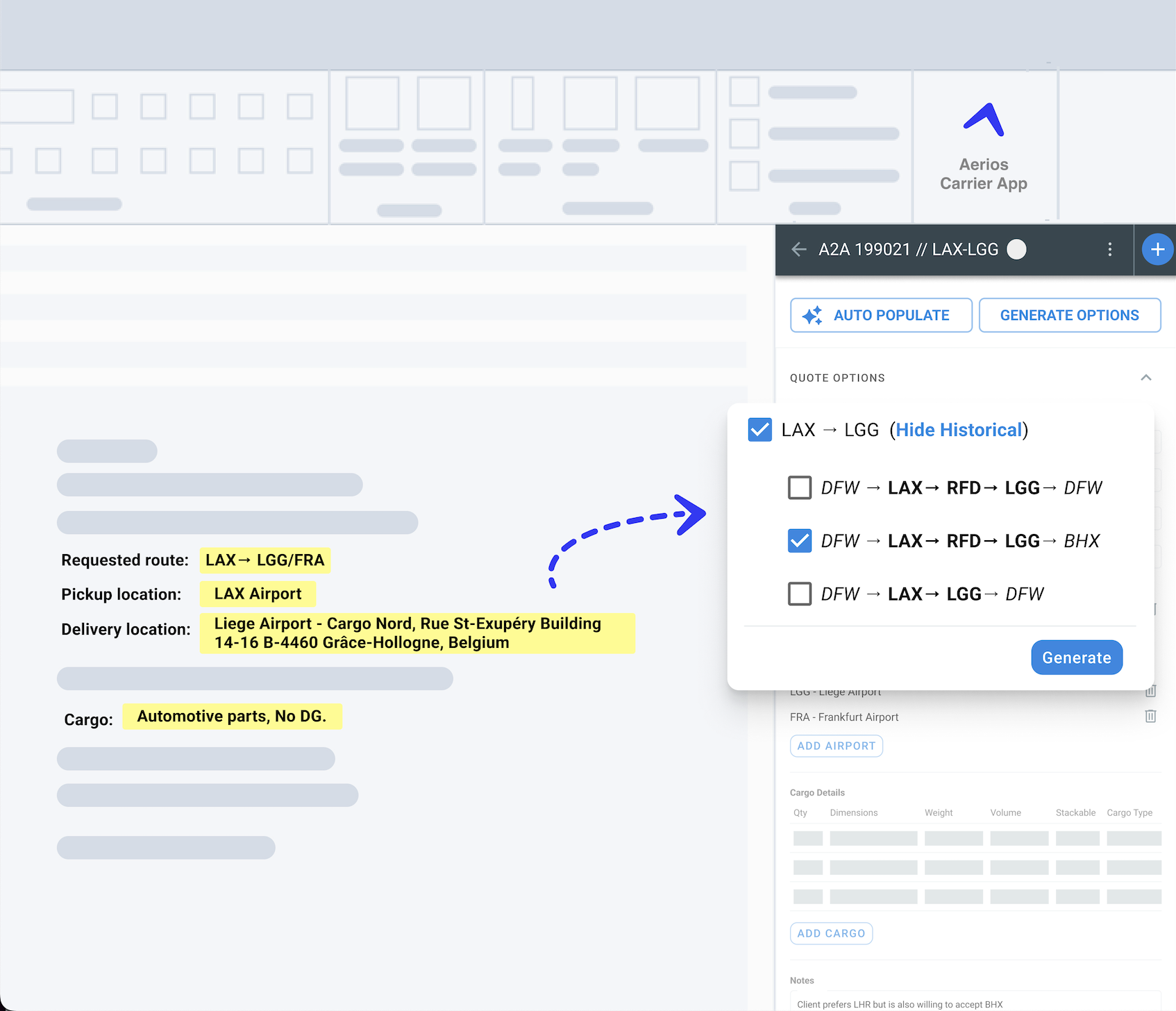
AI and automation are already transforming outdated workflows. UK-based Aerios, part of the CargoTech group, has developed an AI-powered module designed specifically for charter quote generation. The system extracts operational data from unstructured email requests, automatically structures it, and generates multiple routing options within seconds.
Instead of spending time compiling and calculating, you receive structured outputs almost instantly. The platform can reduce quotation time by up to 80% while also improving consistency and accuracy. Multi-airport requests that once required extensive cost recalculation can now be processed efficiently within a centralised workflow.
Solutions like this address the core challenges you face: fragmented communication, manual data entry, slow turnaround times, and inconsistent pricing logic. More importantly, they give you the freedom to focus on higher-value activities.
Carriers, brokers, or charter professionals interested in learning more about Aerios’ commercial pricing capabilities can visit www.aerios.app/book-a-demo to register for a demonstration.